We built PetitionLens to analyze published USCIS appeal decisions on EB-2 National Interest Waiver petitions. In this set of 3,701 appeals decided on the merits since Matter of Dhanasar, Prong 1 was the most frequently identified deficiency. The data describes appealed denials and does not establish the likelihood of approval for any petitioner.
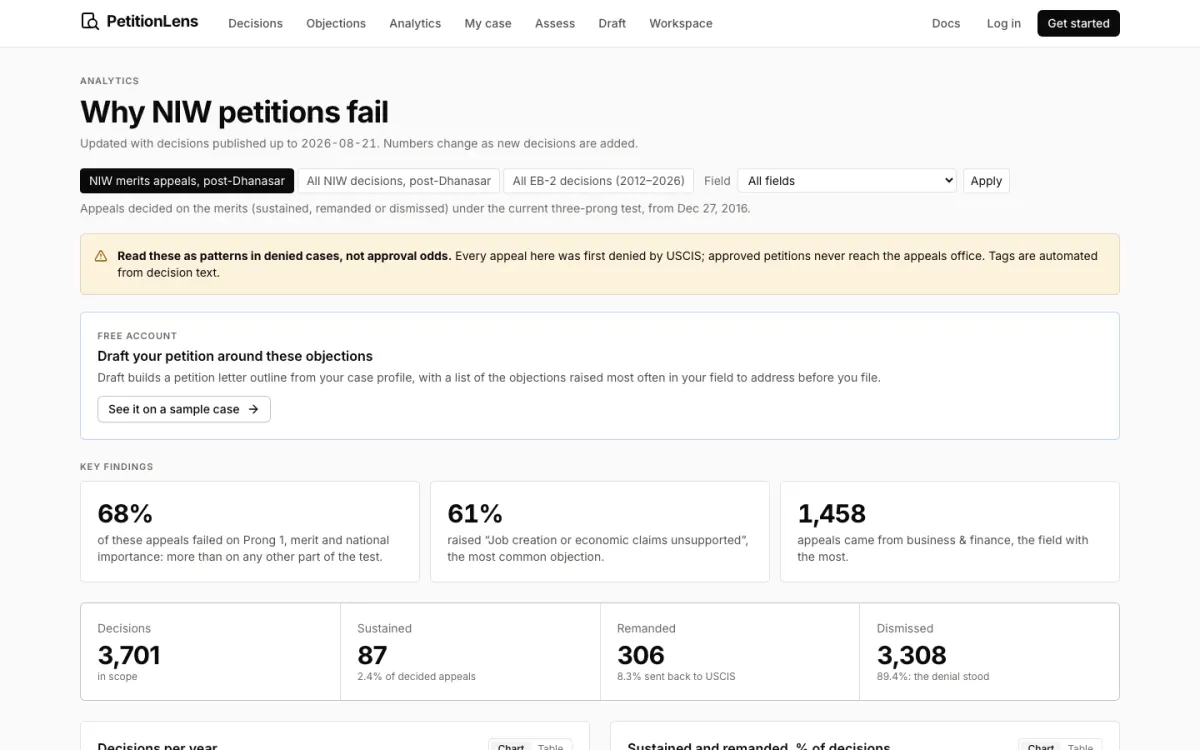
Read this first. Every appeal here was a petition USCIS had already denied; approved petitions never reach the appeals office. These numbers describe where denied petitions struggled, not anyone’s chance of approval. This is research, not legal advice. Talk to an immigration attorney about your own case.
The data
The scope is non-precedent decisions of the U.S.CIS Administrative Appeals Office (AAO) on NIW appeals decided on the merits under the three-prong Dhanasar test, from December 27, 2016 to decisions published up to August 21, 2026. Each decision was matched against 22 objection types using fixed text rules, and every tag keeps the sentence and page it came from. You can check any number below on PetitionLens analytics.
| Outcome | Decisions | Share |
|---|---|---|
| Dismissed (the denial stood) | 3,308 | 89.4% |
| Remanded (sent back to USCIS) | 306 | 8.3% |
| Sustained (appeal won) | 87 | 2.4% |
Finding 1: Prong 1 is where denied petitions break
Under Dhanasar, a petitioner must show EB-2 eligibility, then that the proposed endeavor has substantial merit and national importance (Prong 1), that they are well positioned to advance it (Prong 2), and that on balance waiving the job offer benefits the United States (Prong 3).
| Part of the test | Not met | Share of appeals |
|---|---|---|
| Step 0: EB-2 eligibility | 518 | 14% |
| Prong 1: merit and national importance | 2,535 | 68% |
| Prong 2: well positioned to advance it | 431 | 12% |
| Prong 3: worth waiving the job offer | 118 | 3% |
Two things stand out. Prong 1 is cited in more than two-thirds of these appeals. And the appeals office often stops at the first failed prong, which is why Prong 3 is rarely reached, even though it was the basis of 23% of the original Director denials.
Finding 2: the most common objections are about proof, not merit
| Objection | Decisions | Share |
|---|---|---|
| Job creation or economic claims unsupported | 2,240 | 61% |
| No broader implications shown | 1,834 | 50% |
| Proposed endeavor too vague | 1,423 | 38% |
| Did not show the waiver outweighs labor certification | 772 | 21% |
| Past record does not show influence or success | 744 | 20% |
| Support letters generic or unsupported | 700 | 19% |
| Plan or projections not corroborated | 654 | 18% |
| Argued the field’s importance, not the endeavor’s | 640 | 17% |
| Relied on a labor shortage | 593 | 16% |
| No interest from users, customers or investors | 532 | 14% |
Read the list as a whole and a theme appears. Most objections are not that the work is unimportant. They are that the petition said it was important, or would create jobs, or had support, without documents showing it. Projections without corroboration, letters that praise without specifics, and arguments about why a whole field matters rather than this particular endeavor.
Finding 3: what winning appeals talk about is different
We compared how often each kind of evidence is discussed in appeals that were sustained or remanded versus those dismissed. Discussion is not proof that the evidence helped, but the contrast is sharp.
| Evidence discussed | Sustained or remanded | Dismissed |
|---|---|---|
| Job creation | 20% | 71% |
| Media coverage | 43% | 68% |
| Support letters | 43% | 61% |
| Business plan | 15% | 45% |
| Citations | 34% | 17% |
| Publications | 29% | 19% |
| Peer review | 21% | 7% |
| Grants and funding | 9% | 4% |
Dismissed appeals are dominated by job creation, business plans and media. Successful ones lean on independently verifiable records: citations, peer review, publications and funding. That fits Finding 2: assertions about future economic impact are hard to prove; a documented track record is not.
Finding 4: field and career stage matter
Business and finance is both the largest field (1,458 appeals) and among the hardest, with 6.4% sustained or remanded. Biomedical and life sciences, a much smaller group of 95 appeals, saw 37.9%. By career stage, appeals from entrepreneurs (1,160) were sustained or remanded 5.0% of the time; postdocs (160), 28.1%.
The likely reason links back to the evidence table. Researchers can point to citations and peer review; entrepreneurs are more often relying on projections that the appeals office found uncorroborated.
What this suggests if you are preparing a petition
These are patterns, not rules, and your attorney knows your case. But the decisions point the same way again and again:
- Define the endeavor narrowly. “Proposed endeavor too vague” appears in 38% of these appeals. Say exactly what you will do, for whom, and how.
- Argue the endeavor’s importance, not the field’s. That AI or healthcare matters nationally is not in dispute; whether your specific work has implications beyond one employer is.
- Document every economic claim. Contracts, letters of intent, investor commitments and revenue records carry weight; projections alone usually do not.
- Make letters specific. A letter that explains what you did, how the writer knows, and what changed as a result is worth more than several that praise in general terms.
- Read the decisions in your own field. You can search them by field and objection, free, on PetitionLens.
Method and limits
Decisions are US government works published by USCIS. Objection tags and prong outcomes are assigned by fixed text rules from the appeals office’s own sentences, not by an AI model, and can be wrong; each one links to its source sentence so it can be checked. Countries and fields are read from decision text and are not nationality data. Figures update as USCIS publishes new decisions, so the live numbers on PetitionLens may differ slightly from this snapshot.