The problem
Schools are being told to teach AI. Most of what is on offer either teaches students to type prompts into a chatbot, or assumes a teacher with a machine learning background, which almost no school has. Neither leaves a school with a course it can run again next year.
We set out to build the opposite: a course where students build the thing themselves, in Python, from the mathematics up, and where any good teacher can lead the room.
What we built
A curriculum with a ladder
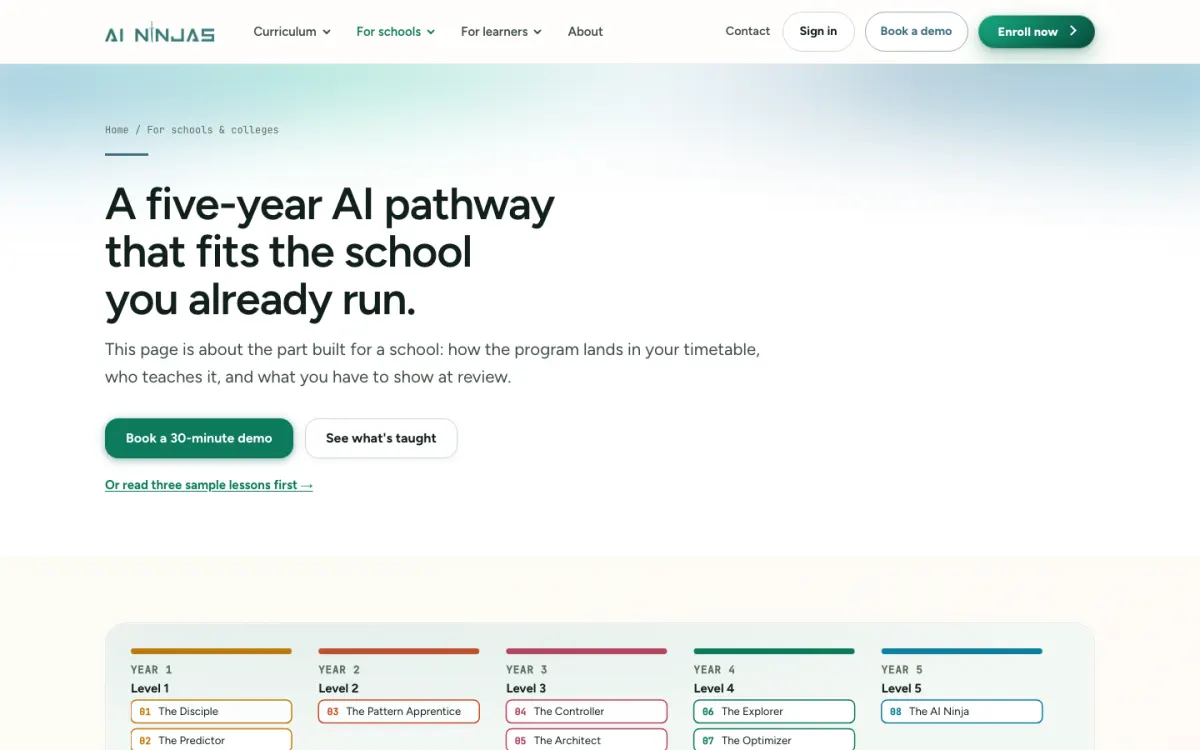
Five levels and eight modules, named for what the learner becomes: The Disciple, The Predictor, The Pattern Apprentice, The Controller, The Architect, The Explorer, The Optimizer and The AI Ninja. Every module runs the same loop (theory, quiz, guided lab, lab quiz) and ends in a mastery check passed with working code. Three threads run through all of it: Python, the math AI actually uses, and computer vision.
All 265 lessons were written by Syed Yasin, our partner in AI Ninjas: an AI scientist with two granted U.S. patents in machine learning. That shows in the design: students finish able to explain why a model reached its answer, not only how to run it.
A platform built around evidence
Every student starts with a 30-minute diagnostic that sets a baseline. Each module releases a badge only when its mastery check is passed. Each level certificate needs a rubric-graded artifact, so the credential says what the student can do, and the person receiving it can verify it.
For schools we added the layer an institution needs: the school’s own branding on the sign-in page, rosters and grades synced with Google Classroom, and three reports named for the occasion they are for: department review, parent-teacher conferences, and inspection.
Training that removes the staffing problem
The most important design decision was to put the subject knowledge in the materials rather than the teacher. Every session has a mentor guide with the answers, the common misconceptions and the sticking points marked. Teachers complete a 45-minute get-started session and a program onboarding, then get co-teaching and a named support team. Training is included in the license, not sold as an extra.
Student data, handled like a school would
The student data policy and data processing agreement describe the information collected, the parties’ responsibilities, available settings, and retention practices. Schools can review those documents when assessing the program under applicable student-privacy requirements, including FERPA and COPPA.
Decisions that mattered
- Build, do not prompt. Every module ends in code that runs. It is harder to teach, and it is the reason the credentials mean something.
- Short lessons. Two to seven minutes, built on spaced repetition, so progress happens in a lunch break and fits a school schedule without a new period.
- Publish the curriculum. The whole program, three full sample lessons and the student data policy are public. Schools decide after reading, not after a sales call.
- One curriculum for everyone. A school cohort, a self-paced adult and a tutoring center partner follow the same eight modules to the same standard.
Where it is now
More than 200 students have been trained on the program. It is sold to schools as a license with teacher training and reporting included, to individual learners as a one-payment enrollment, and through tutoring center and licensee partners.
What this means for your project: if you are a school or training provider, this is the product. If you need a learning platform, curriculum or training program of your own, this is the team and the process that would build it. See the AI Ninjas program, the free class pilot for schools, or AI education & LMS development.