The problem
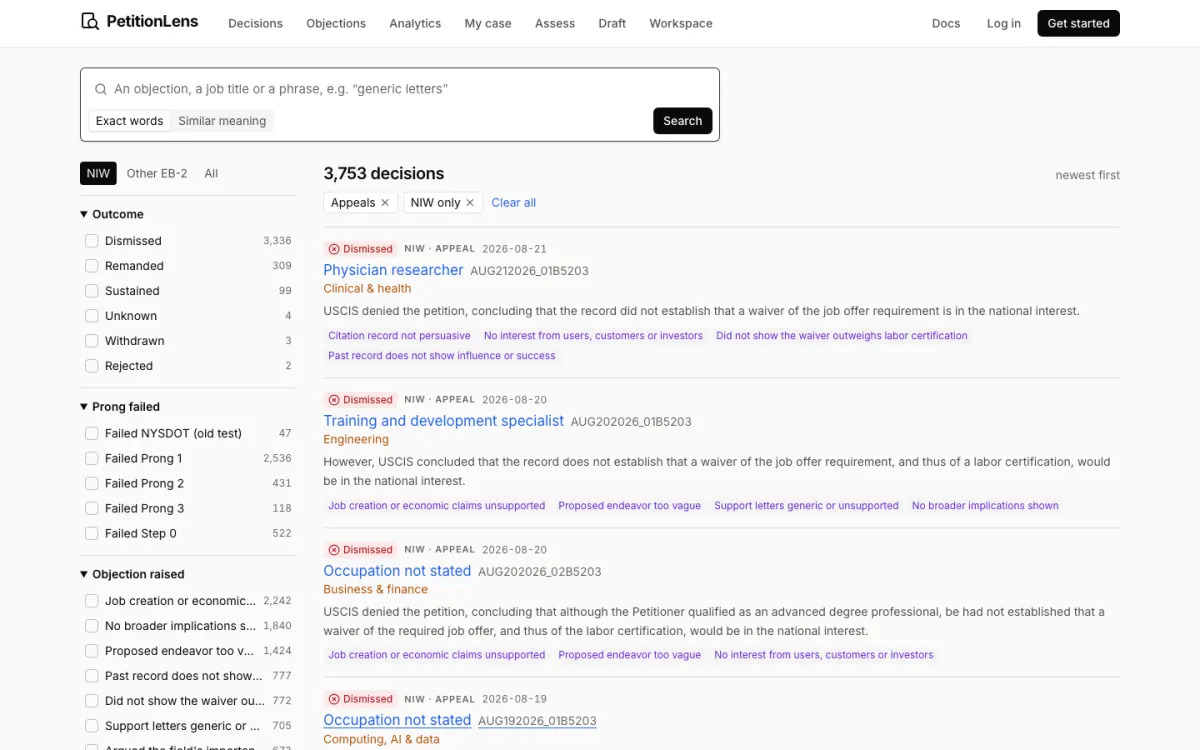
EB-2 National Interest Waiver petitions are evaluated under the three-part test established in Matter of Dhanasar. When a petition is denied and appealed, the U.S.CIS Administrative Appeals Office publishes a decision. These decisions provide a public record of the issues discussed in appeals, but thousands are published as PDFs without a way to search by the reason a petition was denied.
The decisions document issues raised by the appeals office, including how petitioners describe proposed endeavors, present supporting evidence, and address national importance. Reviewing them can help researchers understand the published record, but it does not replace advice about an individual petition.
What we built
A pipeline from PDF to checkable sentence
- Collect non-precedent AAO decisions as USCIS publishes them.
- Read the text page by page, with outcome, field and prongs discussed.
- Match each decision against a catalog of 22 objection types, prong by prong.
- Keep the proof: store the matched sentence and its page with every tag.
Rules where proof matters, AI where it helps
The most important call on this project was where not to use a language model. Objection tags and prong outcomes are decided by fixed text rules, read only from the appeals office’s own sentences. If the wording points both ways, the prong is marked unclear and left out of every count rather than guessed. A user can always click through to the sentence and judge for themselves.
AI is used for what it is good at and where the result is easy to check: finding decisions with similar meaning to a search. That embedding model runs on the product’s own server, so no decision text or case data is sent to an outside AI service.
Analytics that refuse to overclaim
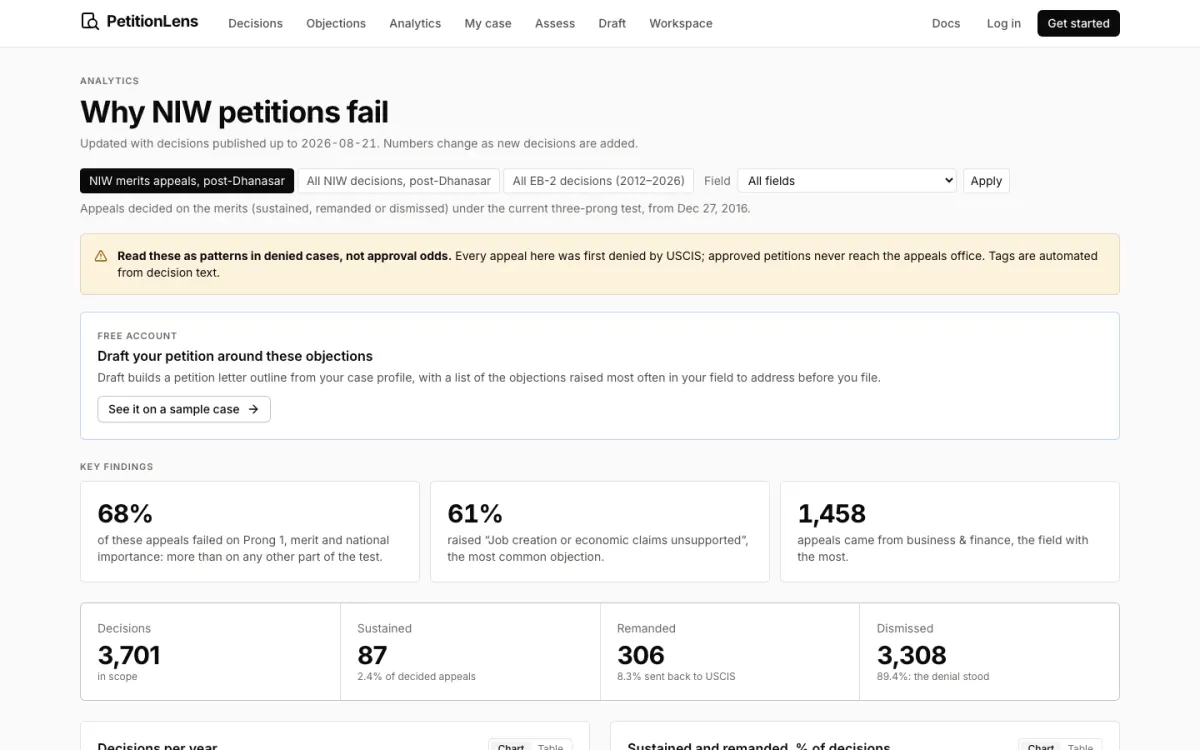
Every appeal in the data was a petition USCIS had already denied, so the numbers describe where denied petitions struggled, not anyone’s chance of approval. The product says so next to every chart. That honesty is a feature: it is why the analysis can be trusted. Read what the data shows in why NIW petitions get denied.
Tools for the applicant’s own case
Beyond research, applicants can build a case profile, run an evidence check and draft a petition outline that addresses the objections raised most often in their field. These tools are built from fixed rules and templates, and they report what a profile records rather than predict an outcome.
Decisions that mattered
- Traceability over cleverness. No tag without a sentence and a page.
- Privacy by architecture. Semantic search on its own server, not a third-party AI API.
- Plain English. Each of the 22 objections has an explanation, the Policy Manual text behind it, and the appeals where it came up.
- Free to search. No account needed, so the people who most need it can use it.
What this means for your project: if your organization sits on a pile of documents (contracts, case files, policies, reports), this is the pattern we would use: a pipeline that keeps the source for every finding, and AI only where its output can be checked. See AI consulting.
PetitionLens is an independent research tool, not a law firm and not a source of legal advice. It is not affiliated with USCIS. It is built and operated by NeuralPath Dynamics. Consult a qualified immigration attorney about an individual case.