AI readiness assessment
Two weeks, fixed fee. We interview the people doing the work, look at your systems and data, and hand you a ranked list of AI opportunities with estimated hours saved, cost to build and risk.
AI consulting & implementation
We find the work in your business that AI can genuinely take off people’s plates, prove it on one workflow with a number agreed up front, then build it into the tools your team already uses.
The problem
The chatbot impresses in the meeting, then nobody uses it because it does not know your products, cannot see your systems and gives an answer nobody can check. We start from the work, not the model.
Two weeks, fixed fee. We interview the people doing the work, look at your systems and data, and hand you a ranked list of AI opportunities with estimated hours saved, cost to build and risk.
Four to six weeks on one workflow. Before we start, we agree the measure: minutes per ticket, documents processed per hour, error rate. At the end you see the number, not a slide.
The pilot hardened for daily use: connected to your CRM, inbox, drive or database, with logging, access control, cost limits and a way for staff to flag a bad answer.
Internal assistants that answer from your policies, manuals, contracts and past tickets, and show the source for every answer so staff can check it in one click.
A plain-English AI use policy, a data classification your staff can follow, and vendor choices that keep client data out of model training. Written for your size, not a bank’s.
Hands-on workshops for staff on the tools you have approved, using your own documents and tasks. The same people who trained hundreds of students on AI Ninjas run them.

Where AI pays first
The work below is where we most often find hours worth saving. Every row keeps a person in the loop wherever a mistake would cost money or trust.
| The job today | What AI takes on | What stays human |
|---|---|---|
| Answering the same customer or parent questions by email | Drafts replies from your own policies and past answers, with sources | Sending anything that commits money or a date |
| Reading invoices, forms and applications | Pulls the fields into your system and flags anything missing or odd | Approving exceptions |
| Searching through years of documents | Finds the passage that answers the question and links to the page | Deciding what the passage means for this case |
| Writing first drafts of quotes, reports and lesson plans | Produces a structured draft from your templates and data | Final edit and sign-off |
| Triaging support tickets and work orders | Categorizes, sets priority and routes to the right person | Anything marked urgent or unclear |
| Summarizing meetings, calls and case notes | Produces notes, actions and owners in your format | Checking before it goes to a client |
From our own products
When we built PetitionLens, a research tool over 5,945 immigration appeal decisions, we deliberately did not let a language model decide which objections a decision raised. Lawyers and applicants need to check every claim, so each tag is matched by fixed text rules and stores the exact sentence and page it came from.
AI is used where it is strong and checkable: finding decisions with similar meaning to a search, running on the product’s own server so no case text leaves it. That is the judgment we bring to your project: AI where it earns its place, plain rules where you need proof.
Read the PetitionLens case study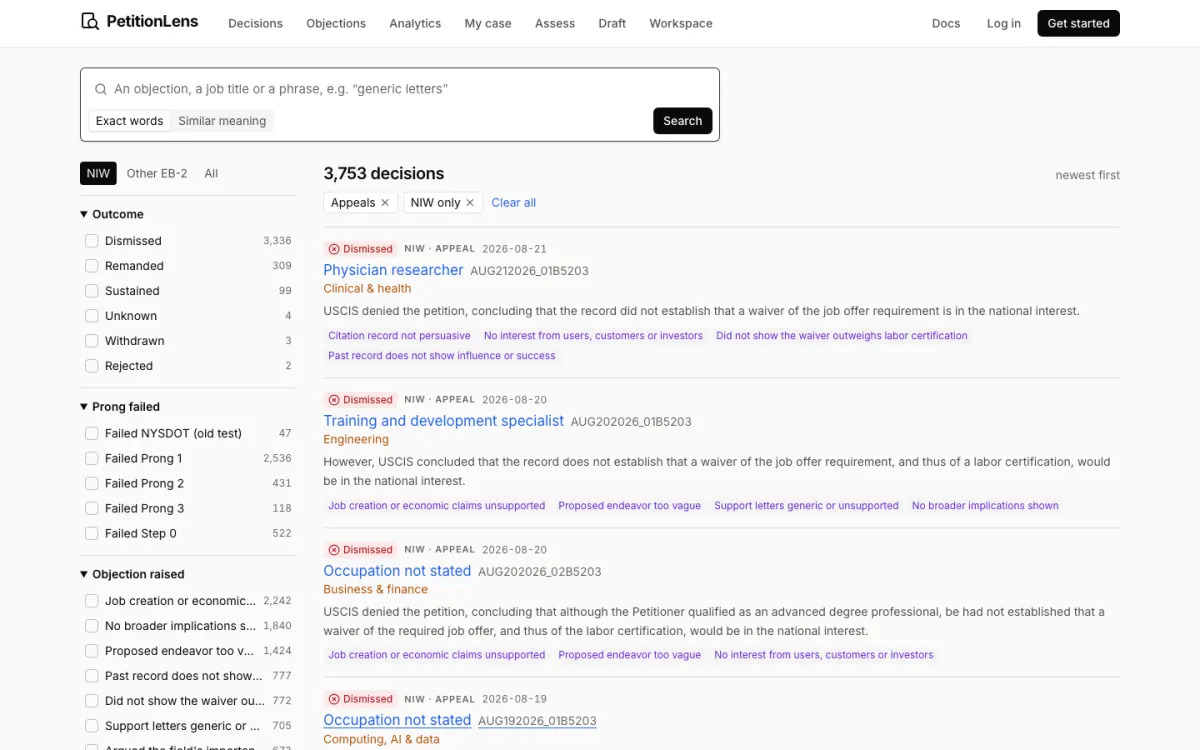
Engagement
| Phase | Length | You get | Commitment |
|---|---|---|---|
| AI readiness assessment | 2 weeks | Ranked opportunity list, cost and risk per item, recommended pilot | Fixed fee |
| Pilot | 4 to 6 weeks | A working tool on one workflow, measured against the agreed number | Fixed fee, success measure in writing |
| Production build | 6 to 12 weeks typical | Integrated, monitored system, staff trained, documentation handed over | Fixed scope per phase |
| Run & improve | Monthly | Monitoring, model and prompt updates, cost reviews, new use cases | Cancel with 30 days’ notice |
Questions
A written report, usually ten to fifteen pages, listing each opportunity we found with the hours it would save, what it would cost to build and run, the risks, and what has to be true about your data first. It ends with one recommended pilot. You own the report and can take it to any vendor.
No. Finding out how usable your data is happens during the assessment. Often the first project is a small clean-up or a better form, which pays off whether or not AI comes next.
Whichever fits the job, the budget and your data rules. That can be a hosted model from a major provider under business terms, or an open model running on your own server. We design so the model can be swapped later without rebuilding the system.
That is not what we build for. The projects that work take the repetitive part of a job away so people spend their time on the part that needs judgment. We design every system so a person approves anything that commits money, a date or a promise.
Yes. We run half-day and full-day workshops on the tools you have approved, using your own documents, plus a short written policy staff can actually remember. For schools, see our teacher training.
Next step
Book a 30-minute call. Tell us where the hours go. We will tell you whether an assessment is worth it for you, and what it would cost, before you commit to anything.