The brief
Ahmad Edu Consultant guides students through applying to universities abroad: choosing a country, shortlisting universities, preparing documents, applying, and getting the visa. Before this project, its only channels were walk-ins and word of mouth.
A student choosing a consultancy is trusting it with original documents and a large sum of money. The things that settle that trust (a registered company, a named person, guidance that cites its source) do not fit in a phone call. They fit on a page.
We scoped the work against an outcome, not a page list. The question was not “what pages do you want?” but “what has to be true for a student to contact you?”
What we built
Five destinations, compared side by side
Each destination (the UK, the U.S., Canada, Australia and Germany) has a full page: entry requirements, English test scores, tuition and living costs, the visa route step by step, and the right to work after graduating. The home page puts the five side by side so a student can see at a glance which are realistic for their grades, scores and budget.
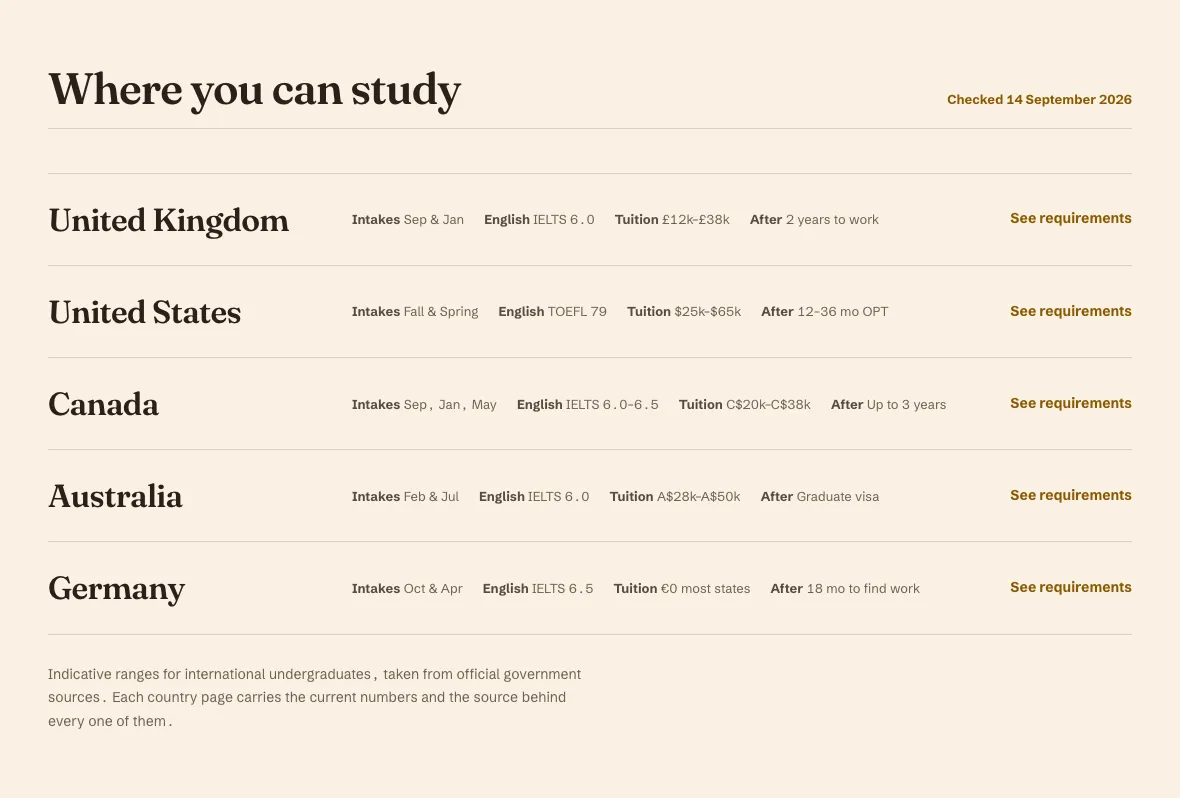
Every number sourced and dated
Visa fees, tuition ranges and financial thresholds change every intake, and students budget against them. Every figure links to the official government source it came from (GOV.UK, IRCC, Australian Home Affairs and others) with the date it was checked. That lets a student verify before they commit, and it makes it obvious when a number is due for an update.
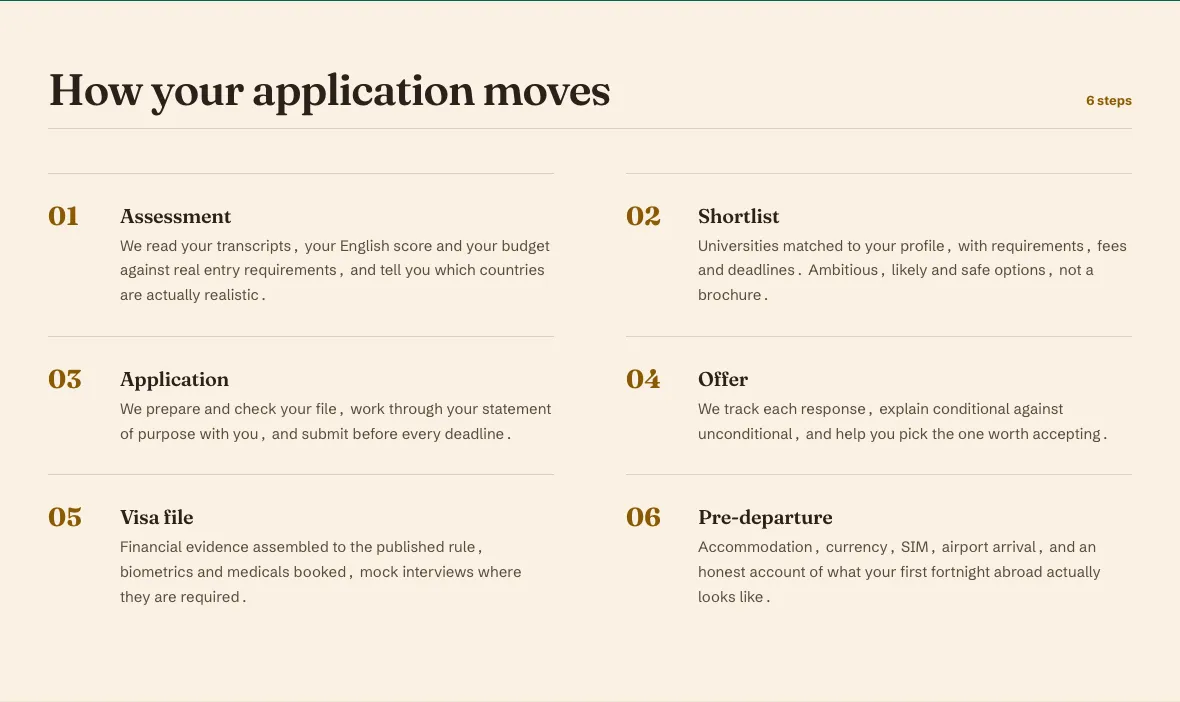
The whole journey, in six steps
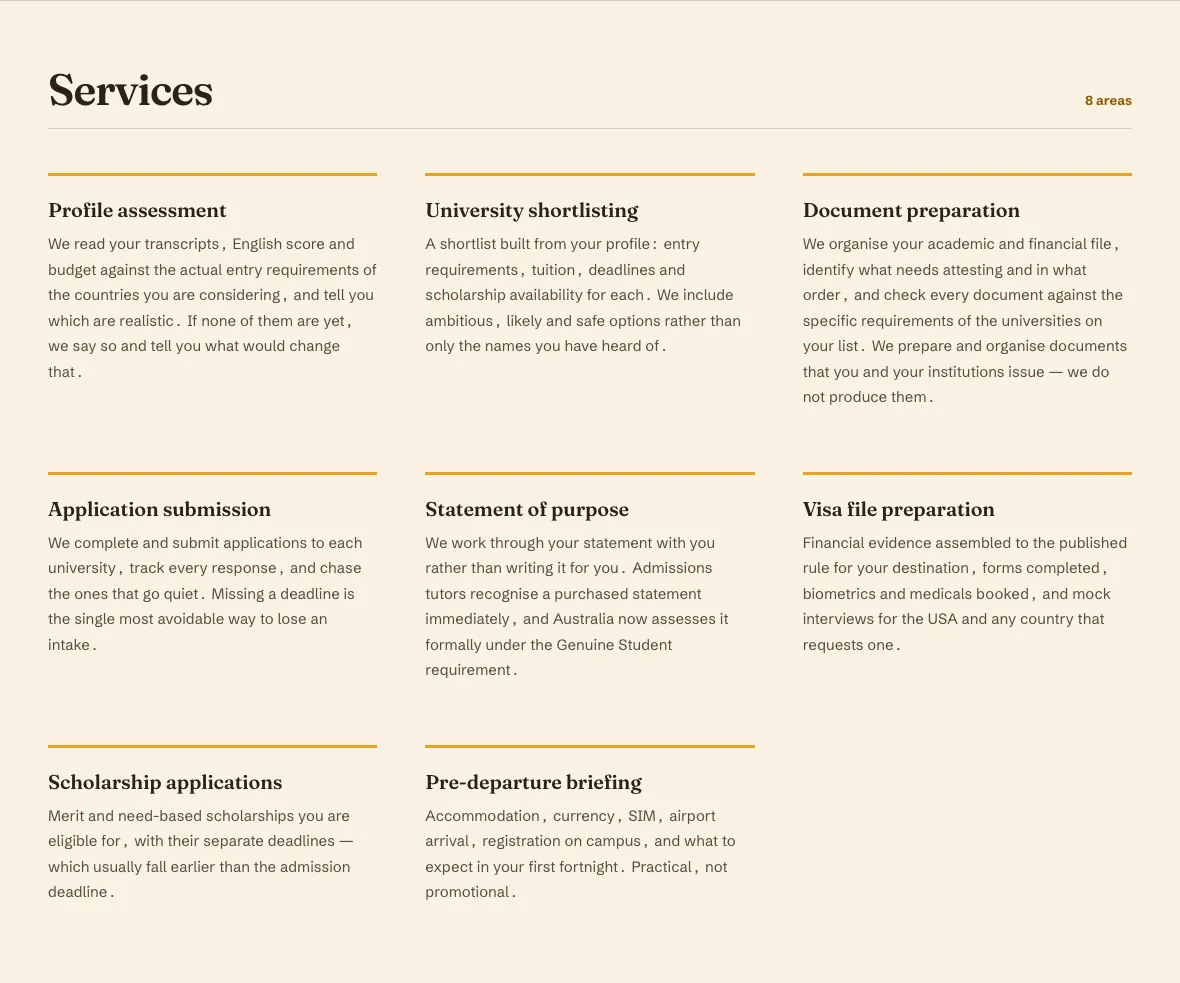
Students arrive anxious about a process they have never been through. The site lays it out end to end (assessment, shortlist, application, offer, visa file, pre-departure) and explains each of the consultancy’s eight services in plain words, including what it will not do, such as write a student’s statement of purpose for them.
Tools that do part of the counselor’s job
A document readiness checklist lets students check off what they already hold and see what to collect next, with progress saved on their own device only if they choose. Guides cover English tests, document attestation, and whether studying abroad is worth it, with published data that includes the parts that do not favor it.
A route straight to a counselor
The inquiry form asks what a counselor would ask first (qualification, destination, level of study), so the first reply is useful. WhatsApp sits beside it on every page, because that is the channel most international students actually use.
Built to be found, and fast on a phone
Page structure, structured data describing the business, a sitemap, and destination pages written around what students actually search (“study in the UK”, “student visa requirements”) were part of the build, not an afterthought.
“Several decisions here were not things we knew to ask for. They were proposed, argued for in terms of what would go wrong without them, and we were persuaded. That is a different service from taking an order.”
Decisions that mattered
- Dated sources over round numbers. Every fee and tuition range carries the government source it came from and the date it was checked, so a student can verify it and the firm can see when it has gone stale.
- Static pages over an app. Most visitors arrive on a phone, often on mobile data, so the site ships as static files rather than something that has to boot before it can answer a question.
- WhatsApp beside the form, not instead of it. The form captures what a counselor would ask first, while students who would rather message are not pushed through it.
- Publish what the service will not do. Saying plainly that the consultancy will not write a student’s statement of purpose costs a few inquiries and prevents the ones that end badly.
- Cookie-free analytics. No advertising trackers and no social pixels on a site used by under-18s.
The result
The consultancy has an online presence where it had none, and students who previously had no way of finding it now get in touch through the inquiry form. For a business whose whole pipeline was walk-ins and word of mouth, that is the return on the project.
What this means for your business: if you run a service business on referrals (a consultancy, a practice, a school or a trade), the same approach works anywhere: answer the questions customers already ask, show the proof they need to trust you, and make contacting you one step. See digital transformation and software engineering.