Schools & training providers
Paper registers, gradebooks in spreadsheets and course materials in email attachments, moved into an LMS with rosters, assignments and reports in one place. See LMS development.
Digital transformation
We map how work really moves through your organization, then replace the paper forms, shared spreadsheets and re-typing with software your staff will actually use. Off the shelf where it fits, custom where it does not.
Signs you need this
None of these feel urgent on their own. Together they add hours to every week, and the cost stays invisible because it is spread across everyone.

Where we start
A fixed-fee workflow map comes first: who touches each job, where it waits, and which steps exist only because a system cannot talk to another one. You keep the map whether or not we build anything.
What we do
We sit with the people doing the work and draw how a request, order or application actually moves today, every hand-off and every spreadsheet. You get the map whether or not you continue.
If an off-the-shelf tool fits 90% of the work, we recommend it and configure it. If your process is your advantage, we build. We have no reseller commissions, so the advice is straight.
Records migrated, checked and reconciled against the old source. Systems connected so information is typed once. Old and new run side by side until the numbers match.
Short sessions for each role, a one-page guide per task, and an engineer on call for the first weeks, because adoption is where most transformations quietly fail.
Typical projects
These are the transformations we are asked for most. Each starts with a fixed-fee workflow map.
Paper registers, gradebooks in spreadsheets and course materials in email attachments, moved into an LMS with rosters, assignments and reports in one place. See LMS development.
Phone-and-paper booking replaced with online and messaging-based booking, patient information pages that answer the common questions, and intake forms that land in the right system.
POS, inventory and accounting joined up so sales, stock and margins are visible per site each morning instead of at month-end. Hardware installed by our own field crews.
Client intake, document collection, e-signature and matter tracking in one flow, with a portal so clients stop emailing “any update?”.
Volunteer, donor and program records consolidated from several spreadsheets, with the reports funders ask for produced in minutes.
Job dispatch, checklists, photos and sign-off on a phone, feeding straight into invoicing, so the paperwork is done when the job is.
Example from our work
For Rehab Medical, a family medicine practice in Cairo, we replaced phone-only booking with WhatsApp booking from every page, and wrote condition pages in English, Arabic and French so patients arrive knowing what a visit involves.
The same pattern works for any practice or service business: answer the common questions in public, make booking one tap, and let staff spend the phone time on the patients who need it.
Read the case study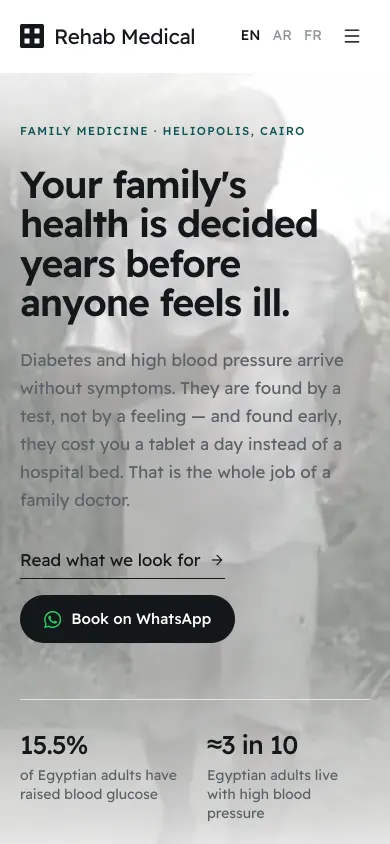
Next step
Pick the process that annoys your team most. We will map it, price the fix and tell you whether it needs software at all.