AI Ninjas curriculum
Five levels and eight modules, from a student’s first line of Python to a production neural network. 54 guided labs, lessons of two to seven minutes, and a mastery check with working code at the end of every module.
AI education for schools & districts
A five-year AI curriculum where students build working models in Python, program training that turns any subject teacher into its instructor, and the learning platform to run it. Built by NeuralPath Dynamics as AI Ninjas.
Not a K-12 school?
This page is written for schools and districts. The curriculum, the standard and the credentials are identical for everyone else; what changes is who delivers it and what reporting you need.
Community colleges, CTE and dual enrollment, continuing education and employer cohorts, with rubrics and hours for your curriculum committee.
AI curriculum for collegesAnyone enrolling on their own, including a parent buying for a child. Self-paced, nothing expires, five verifiable credentials.
Learn AI yourselfTutoring centers and after-school academies delivering the pathway with their own mentors, plus affiliates and country licensees.
Partner with AI NinjasWhat schools get
Most schools are offered an AI tool, or a one-day workshop. Neither leaves you with a course you can run next year. This does.
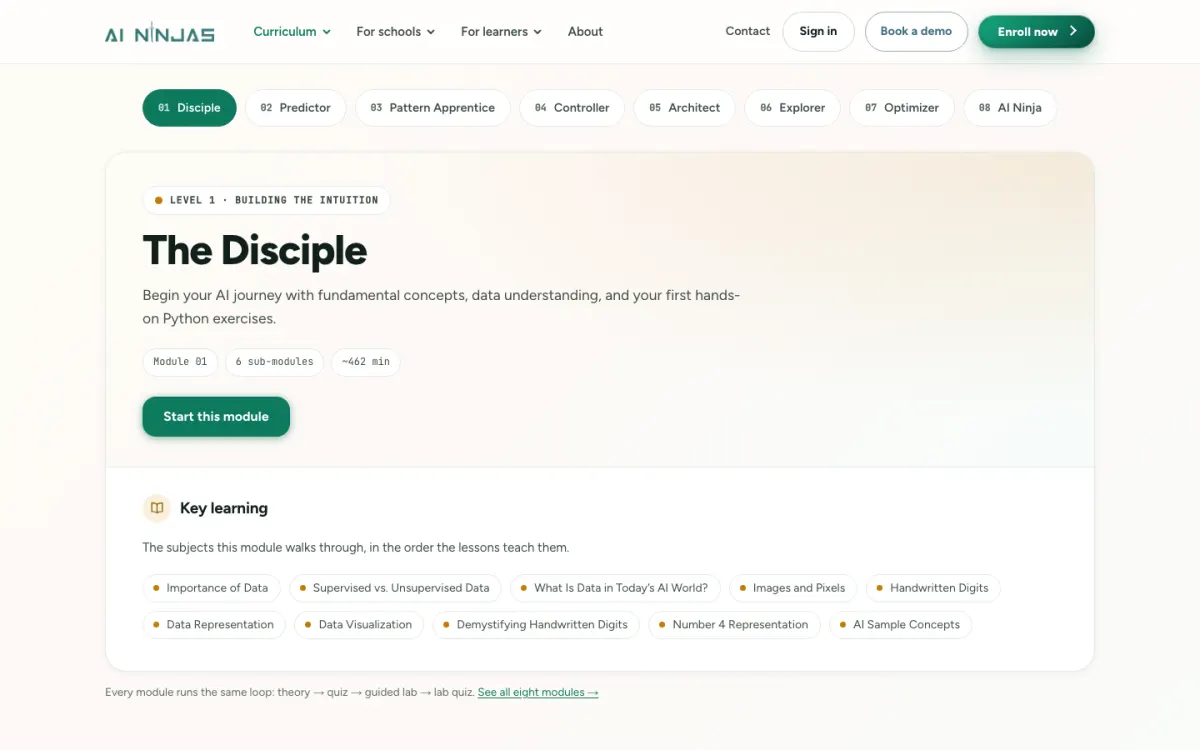
Five levels and eight modules, from a student’s first line of Python to a production neural network. 54 guided labs, lessons of two to seven minutes, and a mastery check with working code at the end of every module.
Included in the school license. A 45-minute get-started session, program onboarding before the first full cohort, then co-teaching and PD as needed. No computing background required.
Your branding on the sign-in page, class lists and grades flowing both ways with Google Classroom, and reports written for the three meetings you actually have: a department review, a parent-teacher conference and an inspection.
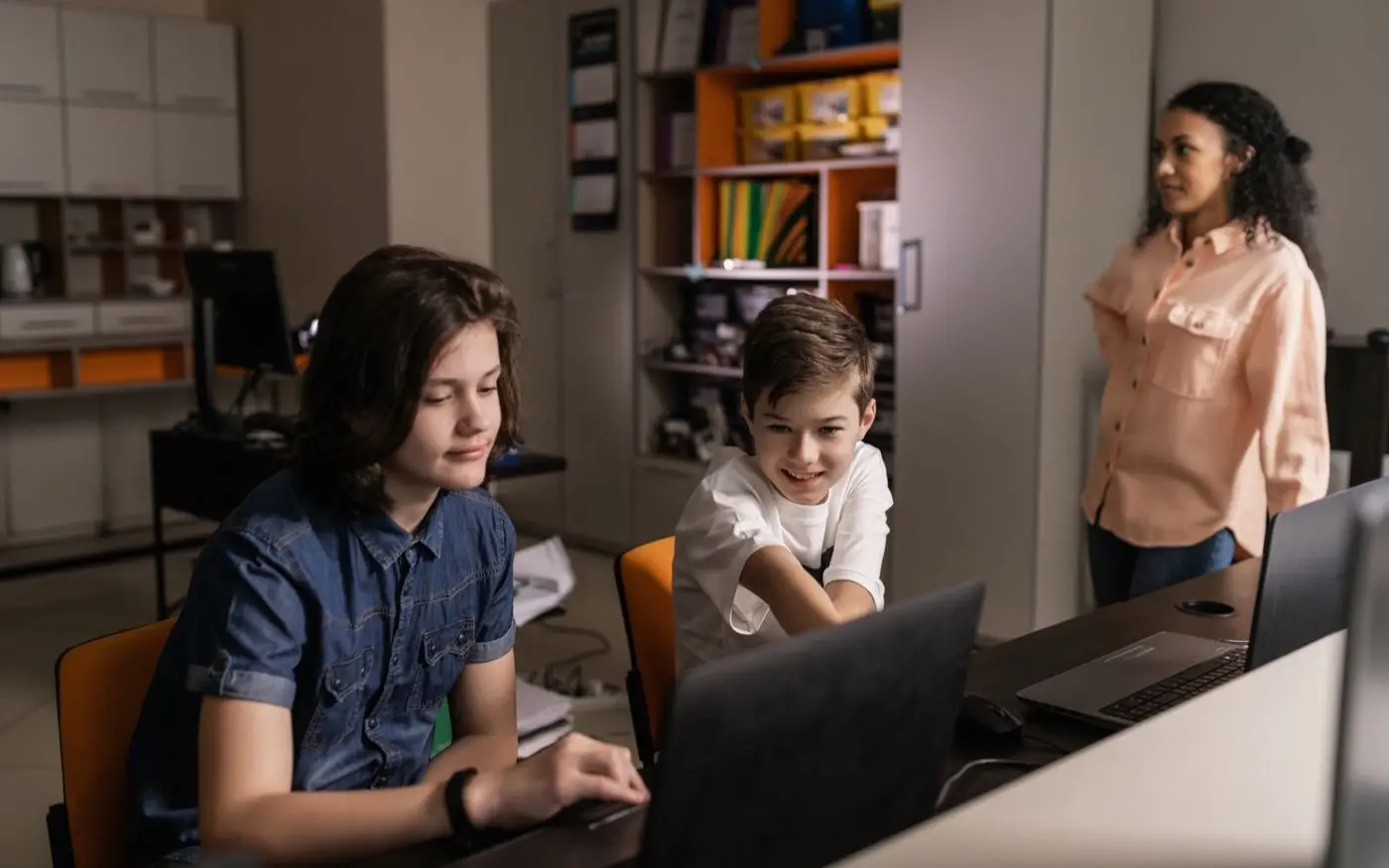
In the classroom
Classes run in a normal period with the teacher you already employ. The platform carries the content, the labs and the grading, so the lesson looks like any other lesson on the schedule.
The pathway
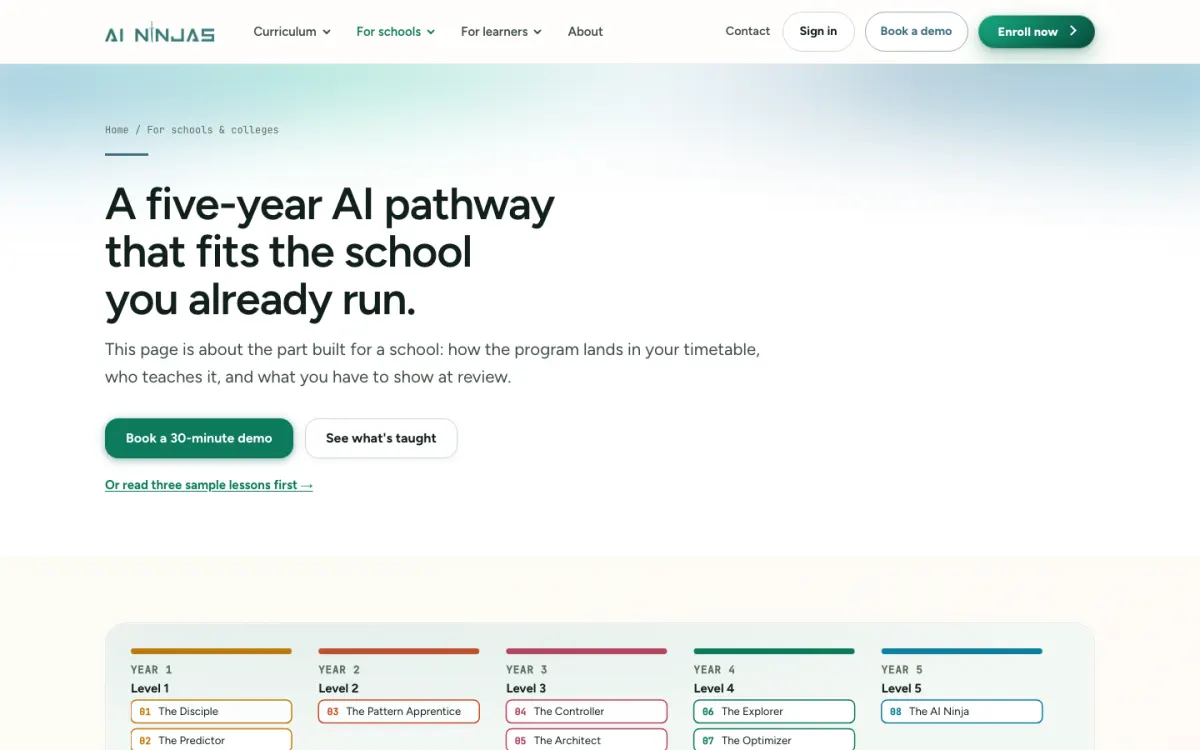
Roughly two modules per academic year, in short lessons that fit the schedule you already have. U.S. schools commonly begin around Grade 8; you choose the entry year.
| Year | Level | Modules | Student builds | Time |
|---|---|---|---|---|
| 1 | Building the Intuition | The Disciple, The Predictor | First working AI programs in Python | ~20 h |
| 2 | Building Confidence with AI | The Pattern Apprentice | A first predictive model | ~10 h |
| 3 | Refined Intelligence | The Controller, The Architect | A two-layer neural network | ~25 h |
| 4 | Precision & Efficiency | The Explorer, The Optimizer | A three-layer network with backpropagation | ~22 h |
| 5 | AI Mastery | The AI Ninja | A production model in Keras and TensorFlow | ~16 h |
Every level ends with a rubric-graded artifact and a digitally verifiable certificate; every module releases a badge. Source: AI Ninjas for schools.
Teacher training & PD
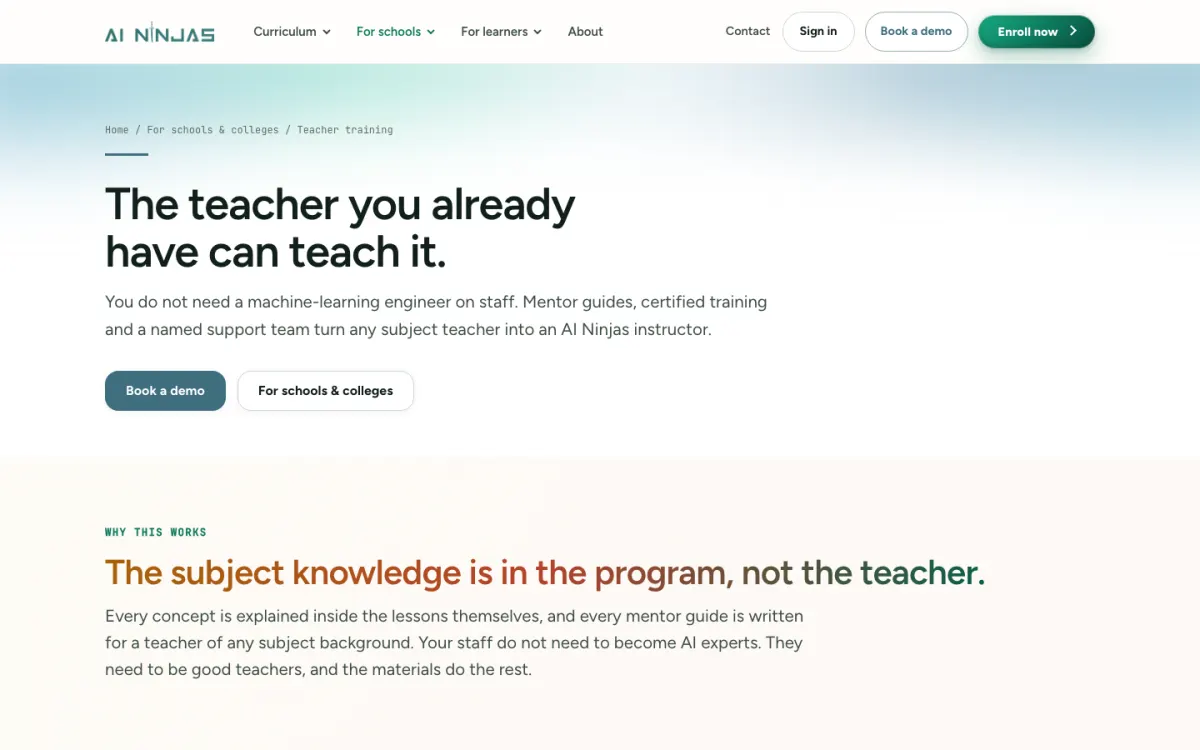
The subject knowledge sits in the materials, not in the teacher. Each lesson explains its own concept, and the session notes mark where classes usually get stuck and what to say when they do. Teachers run the room and ask the questions; they are not asked to be researchers.
We also run standalone AI literacy PD for whole staff rooms: what generative AI is, how to use it in planning and grading, and how to write an AI policy for students that holds up.
LMS development
We built the AI Ninjas platform ourselves, and we build learning management systems for schools, colleges, tutoring centers and training providers who need more than an off-the-shelf LMS gives them.
Student data & safety
The data processing agreement describes the school’s and provider’s responsibilities for student data. We process student data under that agreement.
Who wrote it
All 265 lessons come from one author, an AI scientist with two granted U.S. patents, which is why students are taught to explain a model rather than operate one.
Questions from schools
No. The mentor guides and the lessons carry the subject knowledge, and training prepares teachers to deliver it, not to do research. That is how the schools teaching it today deliver it.
Students aged 11 and up. No prior coding is assumed. In U.S. schools most start around Grade 8 and continue for five academic years; adults can take the same program self-paced.
No. It runs at roughly two modules per academic year in short lessons. Schools fit it into computing, math, STEM electives or after-school clubs.
Yes, and we recommend it: one class, one teacher, one semester. You see the student work and the reports before committing the whole school.
Yes. LMS development is a separate engagement that starts with a fixed-fee discovery sprint. We will tell you honestly if an existing LMS, configured well, would serve you better.
Next step
Thirty minutes online with someone who teaches it. We will walk through a real lesson, the teacher guide and the reports, and price a one-class pilot for your school.