Our product · aininjas.com
AI Ninjas: the AI course where the student builds the model
Eight modules that take a learner aged 11 or older from their first line of Python to a neural network they built and can explain. Written by a patent-holding AI scientist, taught in U.S. schools today, and open to colleges, tutoring centers and self-paced learners.
Choose your route in
Four ways people run this program
The curriculum is the same for everyone. What changes is who delivers it, what reporting you need and how it is bought. Pick the page written for you.
Schools & districts
A five-year pathway your existing teachers lead, with program training, Google Classroom sync and reports for department review, parent-teacher conferences and inspection.
AI for schoolsColleges & academies
A ready-built AI sequence for community colleges, CTE and dual-enrollment programs, continuing education and workforce training, with rubrics your curriculum committee can read.
AI curriculum for collegesIndividual learners
Students, parents buying for a child, and professionals moving into AI. Self-paced, two-to-seven-minute lessons, five verifiable credentials, nothing expires.
Learn AI yourselfCenters & licensees
Tutoring and after-school centers delivering the pathway with their own mentors, affiliates, and country licensees building a territory.
Partner with AI NinjasWhat is in it
Eight modules, each ending in code that runs
Three threads run the whole way through: Python, the mathematics AI actually uses, and computer vision. Every module closes the same loop of theory, quiz, guided lab, lab quiz and a mastery check passed with working code.
- Lessons
- 265
- Guided labs
- 54
- Hours of material
- 53
- Credentials
- 13
| Module | The learner becomes | And can do this by the end |
|---|---|---|
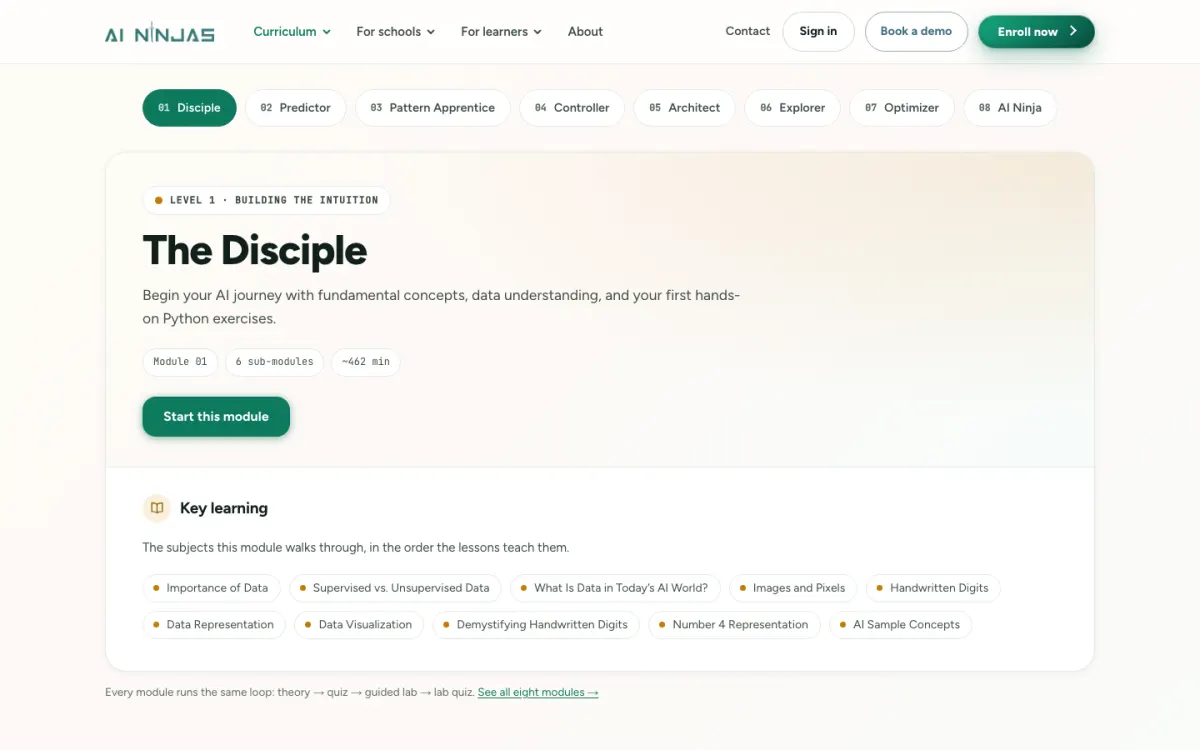
| 1 | The Disciple | Write and run their own Python, and say what AI is and is not |
| 2 | The Predictor | Make a program that predicts from data instead of following rules |
| 3 | The Pattern Apprentice | Train and test a first predictive model, and judge whether it is any good |
| 4 | The Controller | Control how a model learns, and read what the numbers are telling them |
| 5 | The Architect | Build a two-layer neural network from the parts up |
| 6 | The Explorer | Work in three layers, and follow backpropagation through the network |
| 7 | The Optimizer | Tune a network for accuracy and efficiency, not just for an answer |
| 8 | The AI Ninja | Ship a production model in Keras and TensorFlow, and explain its decisions |
Schools run roughly two modules per academic year across five levels. The year-by-year schedule is on the AI for schools page.
Why it is built this way
Build, do not prompt
Most AI courses sold to schools teach students to type instructions into somebody else’s chatbot. That skill has a short shelf life and it cannot be assessed honestly. So every module here ends in code the student wrote and can run.
- The math is taught, not skipped. Students meet the mathematics a model actually uses, at the point they need it, which is why they can explain a result rather than only produce one.
- Lessons are two to seven minutes. Built on spaced repetition, so progress happens in a lunch break and the program fits a schedule without a new period.
- A 30-minute Foundations Challenge sets the baseline. Everyone starts with a measured starting point, so the progress reported later is a real change and not a guess.
- The curriculum is published. The full outline, sample lessons and the student data policy are public. Institutions decide after reading them, not after a sales call.
Credentials
A certificate that says what the learner can do
Thirteen credentials come out of the program: a badge for each of the eight modules and a certificate for each of the five levels. None of them are awarded for attendance.
- A module badge releases only when the mastery check is passed with working code
- A level certificate also needs an artifact graded against a published rubric
- Every credential is digitally verifiable in one click, with the evidence attached
- The same standard applies to a school cohort, a college class and a self-paced adult
That last point matters more than it sounds. A credential is only worth something if the person receiving it can check it, and if it means the same thing wherever it was earned.

Who it is for
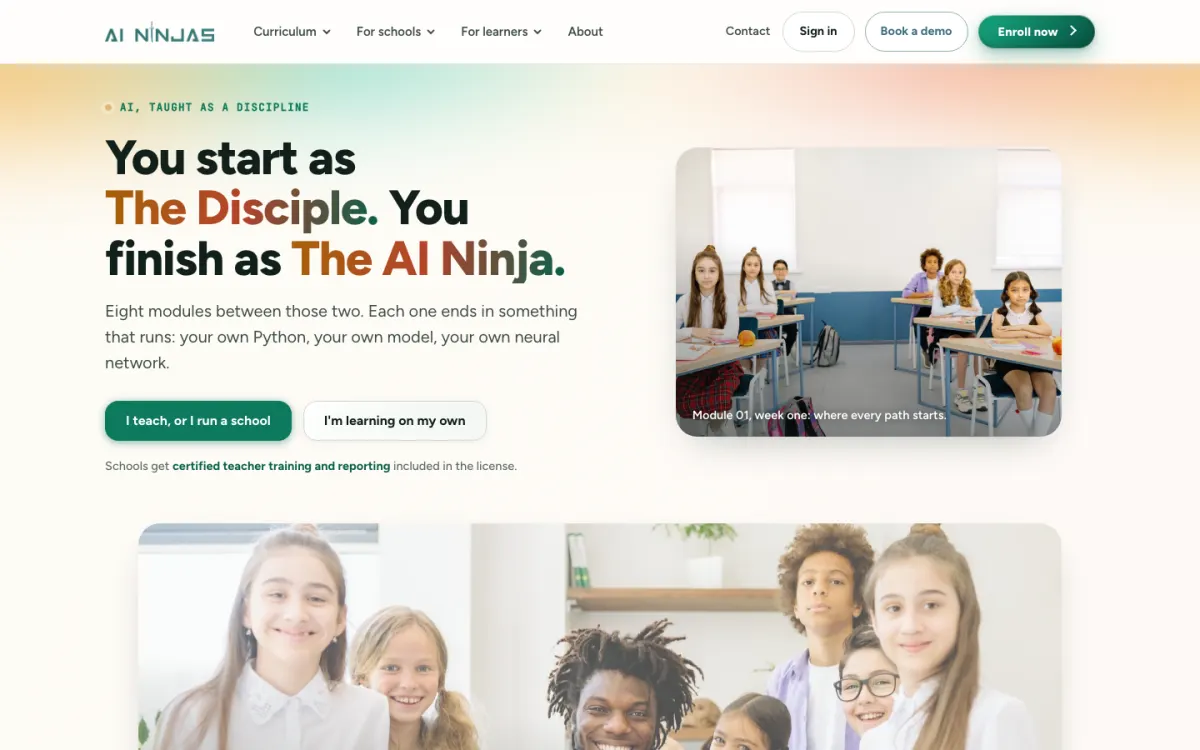
Eleven years old and up, in a classroom or at home
The same eight modules serve a middle school class, a college cohort and an adult learning on their own in the evening. What changes is the pace and who grades the work.
Where it stands
Taught in U.S. schools now, and still open to a pilot
We publish what we can check. The schools teaching it have not given us permission to use their names, so we do not use them, and there are no invented testimonials on this site.
Written by a patent-holding AI scientist
Syed Yasin, AI Scientist, our partner in AI Ninjas and author of its curriculum
All 265 lessons were written by Syed Yasin, an AI scientist with more than twenty years in machine learning and two granted U.S. patents: US 8,977,540 B2 and US 8,583,419 B2. He is our partner in AI Ninjas and the author of its curriculum.
NeuralPath Dynamics built the learning platform, the teacher training, the reporting and the student data policy around that curriculum, and we are the team schools and colleges contract with in the United States.
Straight answers
What people ask about the program
Neither. Students write Python from the first module and finish having built a neural network themselves. Prompting is a skill we assume a motivated student can pick up alone. Building a model, and explaining why it reached its answer, is the part that needs teaching.
That the learner passed a mastery check with working code, and submitted an artifact graded against a published rubric. The credential is digitally verifiable, so a teacher, an admissions officer or an employer can check it in one click and see the work behind it.
Individual enrollment is priced on the AI Ninjas platform. Schools and colleges are quoted per cohort after a 30-minute call, because the number of classes, the training needed and the reporting differ by institution. A school can run a free one-class pilot before any purchase order is raised.
Schools in the United States are teaching it now, and more than 200 students have been trained on the program. We have not been given permission to publish their names, so we do not. On a call we can talk through how a comparable school runs it, and you will be talking to the people who trained them.
The curriculum, the platform and the teacher training go together, because the training is what makes the curriculum deliverable by a teacher who is not a machine learning engineer. If you want a course or platform of your own instead, that is an LMS and curriculum development engagement and we quote it separately.
Next step
See a real lesson before you decide anything
Thirty minutes online with someone who teaches it. We walk through a lesson, the mentor guide and the reports, and tell you honestly whether your school, college or center is a fit.