Courses that build on each other
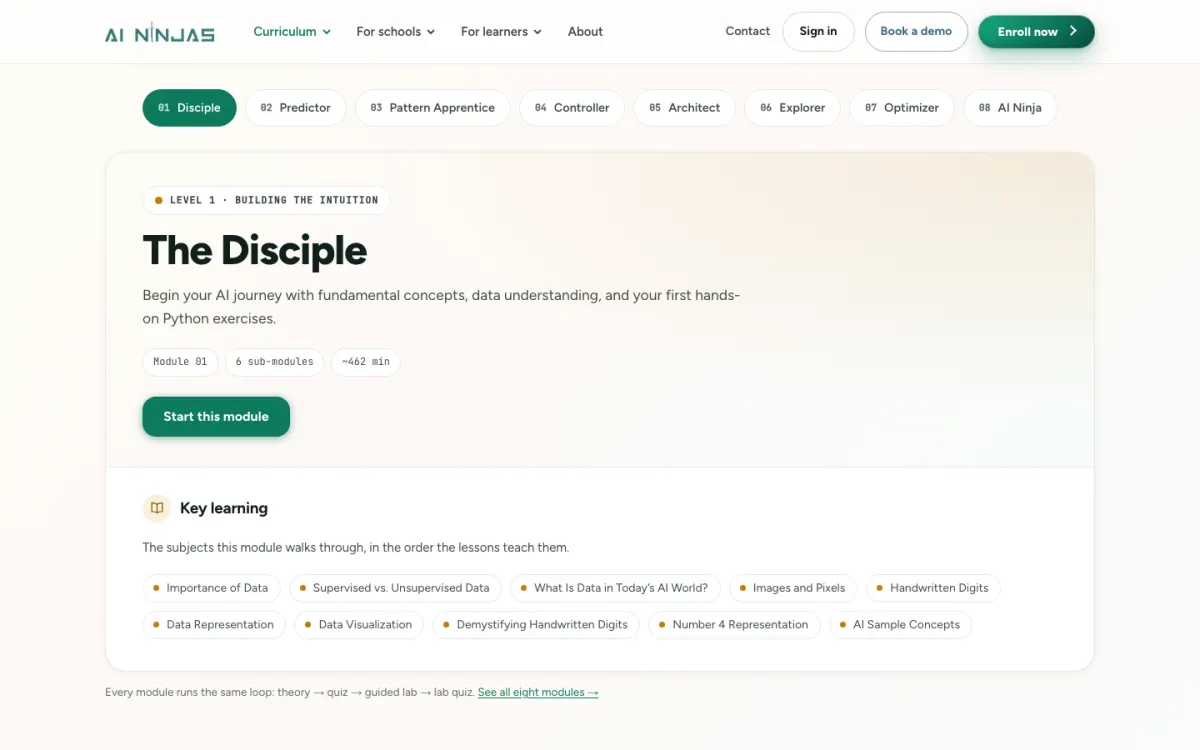
Eight modules in a fixed order, each one assuming the one before. Course boundaries can fall wherever your schedule needs them; our default split is below.
CTE pathways · AI programs of study
The five AI Ninjas levels, arranged as a three-course sequence a career and technical education program can adopt. Students write Python in the first module and finish with a model they built in Keras and TensorFlow. Your own teachers deliver it, and we train them first.
What a pathway needs
One elective is not a pathway. Reviewers look for courses that build on each other, a way to assess technical skill, credentials with evidence behind them, and a teacher who can carry the whole sequence. Here is what the license supplies for each.
Eight modules in a fixed order, each one assuming the one before. Course boundaries can fall wherever your schedule needs them; our default split is below.
Each module closes with a mastery check that only working code can pass. Each level closes with an artifact graded against a rubric we publish, so reviewers can read the standard before any student meets it.
Eight module badges and five level certificates, each one verifiable online alongside the student work that earned it. These are program credentials, not industry certifications, and we label them that way.
No computer science degree is needed. Before the first full cohort, the teacher completes our get-started session and program onboarding, and co-teaching and further PD stay available through the year.
The course map
This is our default split for a three-course pathway. Your district sets the course titles, credits and grade levels. The content and its order stay the same.
| Course | Levels | Modules | What students build |
|---|---|---|---|
| 1. Foundations of AI | Building the Intuition; Building Confidence with AI | The Disciple, The Predictor, The Pattern Apprentice | Their first AI programs in Python, then a predictive model they train and test |
| 2. Neural networks | Refined Intelligence | The Controller, The Architect | A two-layer neural network, assembled piece by piece |
| 3. Applied AI | Precision & Efficiency; AI Mastery | The Explorer, The Optimizer, The AI Ninja | A tuned three-layer network, then a production model in Keras and TensorFlow |
Level and module names come from the AI Ninjas schools outline. Every level ends in a rubric-graded artifact, which gives each course a natural end-of-course assessment.
Before it goes into an application
Pathway applications are read closely, so here is exactly where the curriculum stops.

New Jersey
The state’s Expanding Career Pathways in Artificial Intelligence grant funded two county districts to build an AI and robotics pathway under CIP code 11.0102, the federal classification for artificial intelligence. For a district that was not funded, a curriculum that already exists is a shorter route to the AI courses in that pathway.
We are based in Piscataway, so teacher training can take place in your building.
AI programs across New JerseyHow to start
Our free school pilot works for a CTE class too: one teacher, one semester, no purchase order. Run the opening modules of Course 1 with real students, then decide whether to build the pathway around what you saw.
Questions from CTE directors
Not formally, and we do not claim it. No state has reviewed it as a CTE program, and we have not published an objective-by-objective standards crosswalk. We supply what an alignment review works from: the scope and sequence, learning outcomes for each module, published rubrics and retained student artifacts.
No. Every lab is software: Python, the math behind models, and computer vision. A district building a combined AI and robotics pathway adds a robotics course of its own choosing.
Anyone 11 or older can start, and no prior coding is expected. In a high school pathway, the three courses fit across three school years starting in grade 9 or 10.
A CTE, math, science or technology teacher without a computer science degree. The lessons and mentor guides carry the subject knowledge, and the teacher is trained on the program before the first full cohort. See teacher training and PD.
Yes. Dual-enrollment and postsecondary CTE programs use the same modules at a faster pace, so a student can carry work from high school into a college cohort. See the college program.
Next step
Thirty minutes online with whoever is writing the program of study. We walk through a real lesson, the rubrics and the course split, then send a written proposal. We reply within one business day.